Showing posts with label salmon. Show all posts

Thursday, May 19, 2016

Salmon Farming Here To Stay

0

Report:

KINGSTON, R.I., March 9 (UPI) -- U.S. residents are eating four times as much salmon as they were 20 years ago, most of it imported farmed salmon.
Researchers at the University of Rhode Island found that the value of wild salmon caught in the United States and Canada dropped from $800 million to $300 million between 1980 and 2004, the Providence Journal reported. In 1980, only 2 percent of the salmon sold globally was farmed, which grew to 65 percent in 2004.

"The Great Salmon Run: Competition Between Wild and Farmed Salmon" by Cathy A. Roheim and James Anderson of URI and Gunnar Knapp of the University of Alaska concludes that wild salmon cannot supply the market farmed salmon has created.

Full story Science Daily

Its an important point thats reached when harvesting the wild cannot satisfy the demands of the population. History demostrates that dewindling capture quanities of all wild animals and harvests of wild foods were the main deriving forces that created the need for all types of agriculture.
Read more

Wednesday, March 30, 2016

Veggie Diets For Salmon

0

Things are progressing in finding solutions to developing more environmentally friendly feeds for use in Aquaculture. Feeds with more vegetable based ingredients, leading to further reductions in fish meal and fish oil requirements.

Just found this interesting story by Megan Ogilvie, Special to The Star.

(April 14, 2006) - A browse through the seafood section of your local grocery store may soon reveal a new dinner choice: vegetarian salmon.

A team of Canadian scientists have found that farm-raised salmon can be fed a diet high in vegetable oil without suffering any ill effects. This is good news for fish farmers since it will cost less to feed their stocks. But the consumer may reap the biggest benefit because the fish will have lower levels of contaminants.

The results, presented last week at the Society for Experimental Biology Annual Meeting in Canterbury, England, were met with excitement by people in the aquaculture industry, says Colin Brauner, one of the lead authors of the study and a professor of zoology at the University of British Columbia.

"There is some concern that farmed fish have high levels of some contaminants," says Brauner.

Farm-raised salmon are currently fed pellets made primarily of fishmeal and oil derived from processing wild marine fish such as anchovies, which can be tainted with contaminants, including PCBs and dioxins.

Scientists are eager to find out whether farm-raised fish will thrive on alternative diets that are lower in fishmeal and fish oil and higher in vegetable oils, says Brauner.

The Canadian research may help answer that question. The study found that up to 75 per cent of the dietary fat in a farm-raised salmons diet can come from canola oil — the other 25 per cent comes from fishmeal or fish oil — without the fish suffering any negative health effects. The seven-month feeding trial on more than 7,000 spring Chinook salmon investigated four different diets, with the canola oil diet providing optimal results.

See the entire article at: This Link

This is the type of research that we need more of. Good research in nutrition and feed formulation can go a long way into finding methods to reduce costs and increase safety.

Read more

Monday, March 14, 2016

Cooke to process 240 000 quarantined salmon in N B The Chronicle Herald

0

Cooke to process 240,000 quarantined salmon in N.B. | The Chronicle Herald

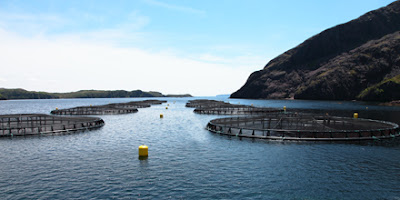
Salmon farming cages at St.Albans newfoundland

LIVERPOOL — A New Brunswick company has begun transporting thousands of fish affected by an outbreak of infectious salmon anemia from a quarantined Nova Scotia aquaculture farm to a fish plant for processing.
Cooke Aquaculture says about 240,000 fish will be transported from its farm off Coffin Island near Liverpool to a fish plant in Blacks Harbour, N.B., over the next month. The processing started last week, it said. Read More

Read more

 
Powered by Blogger