Showing posts with label system. Show all posts

Sunday, May 22, 2016

Aquaponic System Final Design

0

So, here’s the floor plan. As you can see, it is 22.4m long and 6.55m wide. Some system details are as follows:


Aquaponics, ækw??p?n?ks, pisciponics

  • Rearing Tank — The rearing tank will hold roughly 9.5m3 of water. I rounded the ends so the stupid fish don’t get bloody noses all the time. The tank will be stocked every 4 weeks with 120 fish. There will be 6 cohorts of fish aged 4 weeks apart at all times. I will separate the cohorts with suitably sized netting. The position of these divisions will be adjustable in accordance with the growth rate of any given cohort. Harvesting will be done weekly, 30 fish at a time. The outside of the tank facing south will be painted black and exposed to the sun.
  • Hydroponic Tanks — There will be 4 hydroponic tanks. Each will be 12m long and 1.2 meters wide. At a water depth of 30cm, each tank will hold roughly 4.32m3. Plants will be put in net pots which are inserted into holes in Styrofoam boards (1.2m x 0.6m) and dangle their roots happily in the nutrient rich water.
  • Clarifier/Filter/Degassing Units — Each hydroponic tank will get its own set of these highly important if simply designed contraptions. A clarifier, otherwise known as a swirl filter and other such names, removes the lumpier pieces of fish waste. I intend to use 200l plastic barrels. The filter is just another smaller barrel that’s got an armload of orchard netting in it to which the finer solids will be instructed to attach themselves in an orderly fashion.  The degassing tank is another small barrel with a few air stones in it to help remove carbon dioxide, methane, and such.
  • Pump — I’ve purchased a Reef Octopus recirculation pump which will push 7,000l per hour while consuming a frugal 88W. This is roughly 1/4 of the flow rate that the UVI system uses.
  • Air Pumps — I’ve purchased 5 Hailea air pumps. Each would push 60l of air if only I were at sea level instead of 1,200m. They are also frugal, using 55W each. Each hydroponic tank will have its own air pump. Ten of the 12 diffusion nozzles fitted to an air pump will go to air stones spaced equally along the bottom of the respective hydroponic tank. The other two will be fed to the degassing tank. The 5th air pump will be devoted to keeping the fish bubbly and happy.
  • Sump — The sump is just a 1.2m round concrete ring set in the ground at a lower height than the rest of the system. The pump will reside here and replace the water that has flowed by gravity from the rearing tanks through the other system components.  There will be certain losses due to evaporation, plant uptake, leaks, etc. Depending on the water temperature, this loss will be replaced by either hot water produced in a solar water heater (a nice name for a couple of 200l barrels painted black, facing the sun, and enclosed/insulated) or ambient temperature water from a rain barrel. This is also the place where additives such as hydrated lime are gradually added if necessary to raise the PH.
  • Total Water Volume — About 30m3
  • Total Growing Area — 55 to 57.6m2
  • Greenhouse Footprint — 147m2

Read more

Friday, May 20, 2016

Best Plants to Grow in an Aquaponics System

0

 Best Plants to Grow in an Aquaponics System


There are many plants that grow well in soil less farming.  These include vegetables, aquatic plants, flowers and even fruit trees.  There are other vegetables that will not work well in an aquaponic system.  Root vegetables such as carrots, onions and potatoes should not be used in these systems.  You can grow them, but it would not be easy.  They need a medium close to soil like sand in order to grow.


So what plants should I grow in my Aquaponic system?

Leafy Green Vegetables

Cabbage and Lettuce are two of the most common grown vegetables in aquaponic systems.  They grow really well and are easy to take care of.  Other good choices are basil, peas and green beans.

Fruit Vegetables

Some of the top vegetables you see in a typical garden are tomatoes, cucumbers, squash, peppers and even corn.  They all can be grown successfully in an aquaponics system.cucumbers

Viney Plants


Plants that produce vines are a great choice for aquaponic systems.  They are only rooted in the growth bed and can grow elsewhere leaving more room for the other plants.  Examples of these are cucumbers, pumpkins and gords of all shapes and sizes. 


Flowers


Finally there are flowers.  I have seen greenhouses running aquaponics systems that are full of flowers.  You can have a successful business especially in northern areas by selling flowers to local businesses.  There are many popular flowers that can be grown, roses are lilies to name just a few.  They all will grow fast and well in this type of system.
flowers
The trick to being successful with your plants is to try a variety of plants to see which ones will grow well in your climate.  Your plants will need a lot of care at first in order for them to really take off.  You may want to find some supplements.   Seaweed is a very popular supplement that is used in aquaponic systems.  The seaweed extract are great for growth, but you need to be careful what you add to your system.  An additive that helps your plants grow, might cause issues with your fish or bacteria.  Make sure you find additives that will ensure your plants, bacteria and fish all will thrive in your system.

Read more

Tuesday, May 3, 2016

First Custom Contracted Aquaponic System Built!

0

Im pleased to report that I have just completed construction of my first custom aquaponic system for a client based in Little Compton, RI. See more pictures and find out the details by visiting the new Custom Client System page!

First custom built aquaponic system: 4 x 2 x 1 grow bed with 3 x 2 x 1.5 fish tank using an autosiphon

    Read more

    Sunday, May 1, 2016

    Modern Design System

    0

    The future design
    Aquaponics, ækw??p?n?ks, pisciponics
    Aquaponics, ækw??p?n?ks, pisciponics

    Read more

    Monday, April 25, 2016

    Cycling A System Should You Go Fish

    0

    Aquaponic systems are closed loop systems that replicate the naturally occurring symbiotic relationship between plants and fish.  Fish provide nutrients for the plants and the plants clean the water for the fish.  Like all relationships, this one takes time to develop as well.

    Whether you are designing your own system or looking to purchase a prefabricated system you should be aware that it will take some time for your system to function so that fish and plants are both healthy and growing.  The process of establishing this symbiotic relationship is referred to as "cycling".

    You can cycle with fish or without fish.  The choice is yours.  Whether you cycle with fish or without fish, you will need to keep an eye on the water chemistry so go ahead and invest in a good water quality test kit.  These kits will allow you to test for pH, ammonia, nitrites, and nitrates.

    I have cycled systems both ways and I prefer fishless cycling.  I will admit it:  I am a mushmellow.  It bothers me when fish die.  I feel like I am their steward and when they die I have failed them.  The truth is when you cycle with fish some fish are going to die.  During cycling there will be ammonia and nitrite spikes that will kill fish.  It is a natural part of establishing the system.  Even if they are just the cheap little feeder goldfish from the pet store, it hurts me when they die.  So I like to cycle without the fish.

    In fishless cycling you add ammonia to the fish holding tank (that has no fish in it) in an amount sufficient to bring it up to 0.5 ppm.  You then test the water daily until levels fall back below 0.5.  You add ammonia again to bring it up to 0.5 and wait for it to drop.  After a week or two of this you will start to see some nitrites show up.  These are the nitrosomona bacteria that are establishing themselves in the system and will start to convert that ammonia to nitrites.   You should see a big spike in nitrites before the nitrates show up.  Once the nitrates show up that means you have nitro bacters growing in the system. These guys will take nitrite and convert it into nitrate.  Once this cycle is established you can safely add fish to the system. 

    The amount of time it takes to cycle a system without fish can vary from 3 to 6 weeks.  Things that affect the cycle time period are water temperature and pH. Keep your water temperatures on the warm side and the pH in the neutral zone. Also, if you start cycling with water straight from the tap, it will have chlorine in it.  This chlorine is there to kill the unsafe bacteria in your drinking water.  It will also kill your nitrifying bacteria.  That means anytime you use straight tap water you are setting yourself back.  Luckily chlorine readily off-gasses and if you let your water stand for 24 hours the chlorine/chloramine will dissipate and you can safely use it in your aquaponic system.  This is especially true when you need to top off an existing system.

    Cycling takes patience.  In the mean time, enjoy the plants that you put in your system.  You have to have plants for the cycle to be established, so plant some water loving plants.  Things like basil, mint, and tomato will do well in a system that is not cycled.  This is because they like water and the lack of nitrogen doesnt really bother them.  In fact, if nitrogen levels get too high, tomato plants will grow but not bloom!  Onions are also great plants for cycling. Ive even cycled with petunias!

    There is another method of fishless cycling that is mostly promoted by men. It is called "pee-ponics" and instead of adding pure ammonia from the store into the system, human urine (referred to as "hummonia") is added to the system.  Dont really understand why men want to pee into their aquaponic systems, but to each their own.

    You can speed up cycling by inoculating your system with bacteria from a healthy system that is already established.  This can be done by taking water from the filter of a healthy system or simply taking water from a healthy system.  Be very careful when doing this.  If the system from which you take your water is not healthy, then you have just spread its disease to your system.  If you have one already cycled and well operating aquaponic system, then by all means harvest the bacteria from your existing system to jump-start your new system.

    Lastly, you can go to a pet store that deals in aquariums and purchase bacteria in a bottle.  I am not a fan of this because it is pricey and honestly, how long can those bacteria live in a bottle?

    How do you cycle?  Id love to hear your experiences.

    Read more

    Monday, April 18, 2016

    How to start an aquaponic system

    0

    Starting an aquaponic system

    Introduction

    This experiment is an introduction into the functions and management of a small aquaponic system. Like a home aquarium, an aquaponic system requires special attention in the first weeks, since the microbial community in the water and in the plant boxes need some time to get established.


    Learning goals

    • Know why an aquarium requires a filter.
    • Know how to monitor the water quality by using simple aquarium test kits.
    • Be able to explain what the measured factors indicate in terms of water quality, fish health and plant growth.
    • Understand how to react in case of bad water quality in the aquarium.
    Starting an aquaponic system
    Starting an aquaponic system

    Background information

    There are at least three species of living organisms in an aquaponic system. There are fish, plants and bacteria. In our small classroom system we will have about four goldfish in the aquarium, 60 plants in the plant beds and about 100000 billion of bacteria and other very small species in the gravel or LECA. Bacteria have been on this planet for 3 billion years while man exists for at most 3 million years, and our civilisation for just 10000 years. A human being couldnt survive a day without the help of bacteria and neither would the fish and plants in our classroom system.
    The fish need oxygen to survive - in the same way as human beings, i.e. by breathing - but the fish take oxygen from the water and excrete ammonium and carbon dioxide over the gills. There is also ammonium in the excrements (faeces) from the fish. The ammonium in the water can become dangerous to the fish. The bacteria can transform ammonium into a substance (nitrate) which is harmless to the fish and at the same time an important plant nutrient. This process is called nitrification and it is necessary to supply the plants with nitrogen fertilizer.
    So the first thing we need to do before we put any fish in the aquarium, is to start growing a lot of bacteria in the plant boxes, so that they can take care of the fish excrements i.e. the ammonium in the water.


    Another important factor influencing the water quality is pH. It indicates whether the water is acidic, neutral or basic. The pH is measured on a scale of 1-14 with 7 being neutral. Is the pH lower than 7, the water is acidic, if it is higher, the water is basic. Depending on the fish species, the optimum pH varies. Goldfish tolerate variations in pH much more than other fish species, but to avoid stress, the pH should stay within the range of 6.5 - 8.

    Time requirement

    The starting phase should last at least for three weeks.

    Material requirement

    • 1 classroom aquaponic system
    • 1 aquarium test kit for ammonium (NH4+)
    • 1 aquarium test kit for nitrite (NO2-)
    • 1 aquarium test kit for nitrate (NO3-)
    • 1 aquarium test kit for pH
    • 1 bacteria starter package for aquarium filters
    • 1 aquarium thermometer


    Lets start

    Start the biofilter - multiply the bacteria! Fill the system with water and start the air pump. It is important to keep the oxygen level high for the bacteria to thrive. The water pump is now circulating the water through the system. There are different ways to multiply the bacteria. For example you can add a starter package of bacteria, or you add a very small amount of ammonium to the system in order to feed the already present bacteria in the substrate. We suggest to add a fertilizer containing ammonium, to achieve an ammonia concentration of 10 mg/l. If using ammonium sulfate, you would add 4.7 g of the powder to 100 l of aquarium water.

    Is the filter working? If there are enough bacteria in your filter to transform ammonium into nitrate, your filter is working. To find out, you need to measure ammonium, nitrite and nitrate. You can begin with measuring the ammonia concentration and monitor, how every day it is decreasing. After a week you can start measuring nitrite and nitrate, using the sticks from the pharmacist or the aquarium dealer. During the first days you can have some indication of nitrite but when the system is ready you should have no response of nitrite. It normally takes between three to six weeks to multiply the bacteria enough so they can digest the ammonium amount that will be caused by the application of fish food.

    Control and regulate pH! To measure the pH in the water use the pH-sticks. If the value is between 6.5 and 8, there is no need to do anything. If it is above or below that value,change part of the water! If you feel experienced enough, instead of changing the water, you could add formic acid in case the pH is higher than 8. Add one part of the acid to 50 parts of water and use a drop of this solution every day until pH is right. If pH is too low, you can add a tea spoon of calcium hydroxide or potassium hydroxide in a cup of water and use a drop of this until pH has the right level.

    Temperature: Temperature is very critical because it influences other water quality variables. For example cold water can hold more dissolved oxygen than warm water. Fish are very sensitive to changes of temperature, smaller fish being more sensitive than larger ones. Goldfish belong to the group of coldwater fish and prefer temperatures between 18 -25 °C. They will tolerate any temperature from 4-30 ºC however, as long as the water still contains enough oxygen and low amounts of ammonia. Remember that the body temperature of fish is always the same as the water temperature. Therefore, in colder water fish will eat less or stop eating at all when the temperature drops below 9 °C (Mette, 2006). On the contrary, in warmer water fish will digest faster and get a lot more hungry. Be careful, though, not to give too much feed! More feed means that the fish need more oxygen, but in warmer water there is less oxygen. So these two factors are working against each other, and you have the balance in your hand.

    See and feel

    • Ammonia (tolerance value: < 0.8 mg/l) and Nitrite (should be 0 mg/l at all times, max. 0.2 mg/l) (measure each second day).
    • Nitrate - its raising indicates that the filter process has been started (once per week). The nitrate value should be between 10-100 mg/l.
    • pH should be between 6.5 and 8 (once per week).
    • Water temperature should be between 18 - 25°C, depending on the fish species
    • If the values of ammonia, nitrite, nitrate and pH are out of range, stop feeding. In severe cases, change part of the aquarium water.

    Didactical comments

    In order to understand the process of nitrification, or what happens in the filter, some basic knowledge in chemistry is required. However it is possible to explain it in using metaphors: two little animals (bacteria) are responsible to transform the poison (ammonium) into a non toxic substance (nitrate), which at the same time will feed the plants. With the ammonia and nitrite test kit we indirectly measure the existence and quantity of these bacteria.

    Aquaponics, ækw??p?n?ks, pisciponics http://aquaponics-commercial-backyard.blogspot.com.es/

    Read more

    Friday, April 15, 2016

    250 liter aquaponics system Cycling with fish

    0

    The new 250 liters Aquaponis system was in the making for a while and now its ready. This system was planned to reduce transportation and assembly time. The current system is a direct drain to the fish tank, where the growbed is directly on top of the fishtank.

    The dimension of this system is 900 x 900 mm x 300 mm and the fish tank is a 300 liter capacity loft tank that is readily available in the market.

    The wooden framework was developed keeping in mind the outdoor conditions and was treated with a PU coat (weather proof sealant).


    Once the framework was assembled, the inside was lined with a pond liner.
    The growmedia for this system was in two layers .. the lower half was filled with 25mm gravel and the remaining top half was filled with LECA.

    For this system i started cycling with fish.
    the formula i was following in the past was the same i used here. So what i did was once the system was fully plumbed and the water filled in the fishtank, i ran the system for three days without fish.
    Then on the 4th day i added 5 goldfish, and did a water test. After the first week i added another 5 fish and every week gradually i started adding more fish.
    The first few weeks you will notice the PH reducing and the ammonia level slowly building up .. once you see the ammonia building up .. its time to add some seeds so that there will be takers for the nitrate when the bacteria start converting the ammonia into nitrite and then nitrate.

    Here are the results from the testing that was done in 8 weeks.
    you can see the progress gradually.


    Read more

    Thursday, March 31, 2016

    What Equipment You Need for an Aquaponics System

    0

     What Equipment You Need for an Aquaponics System

    An aquaponics system is a symbiotic marriage of plants and aquatic animals cultivated in a recirculating environment. There are various types of aquaponic systems used for growing vegetables or plants. Knowing how big you want your aquaponic system to be before you purchase it will allow you to set a budget. Read on to learn a little about the basic equipment needed for aquaponics systems.

    Fish Tanks and Stand Pipes and Tanks Stands

    Aquaponics is a blend of aquatic animals living in an environment where they provide the nutrients for the plants or vegetables growing in the same water in which they live. To begin creating your aquaponics system, you will need to decide which fish and other fauna you would like to house and how many you need. They will need a tank to live in and the tank requires stand pipes. You will also need to position your tank on a steady area or stand.

    Clarifiers

    You will need clarifiers for your aquaponics system. These are highly recommended as the best way to remove solids from the culture water. They also assist with the de-nitrification process and remove ammonia and nitrates. They are responsible for removing almost all of the water in the recirculation system and they can be used many times over with just marginal replacement needed from flushing the system to remove any solids that get trapped.

    Bio-filters

    Keeping the water clean and balanced in your aquaponics system is essential to keep it running efficiently. Bio-filters are a great way of controlling water pollution by biologically degrading and processing pollutants. There are horizontal bio-filters and upright bio-filter tanks available as well as a range of other types.

    Oxygen Systems

    Because you are keeping fish in your aquaponics systems, you will need an excellent oxygen distribution system. This is one of the must-have features as this is highly intrinsic to the health and growth of the fish. It will distribute oxygen to an optimum level suitable for the fish you have in your system.

    Pumps

    You will need a pump (or multiple pumps, depending on your system set-up) and the pumps serve a very important purpose. They will pump the water around the system, allowing it to be cleaned as it goes through the bio-filter and will return the fresher, cleaner water to the tank for best results.

    Sundries

    There are other smaller items needed to get your new aquaponics system up, running and performing as you need it to. Pipes and tubes and other accessories will be required and the best place to find them is in a kit found at a specialist store on website. Learn as much as you can about how aquaponics work before you commit to buying a complete system.

    Plants and Fish

    You will want your aquaponics system to function well for both your plants and the aquatic creatures you want to live and grow in your system. Choose the right fish that support the plant environment for the best results.

    Read more: http://www.doityourself.com/stry/what-equipment-you-need-for-an-aquaponics-system#.UgubGqxNX0c#ixzz2bxKAE4jn

    Read more

    Tuesday, March 29, 2016

    Integrated Vertical Tube System

    0

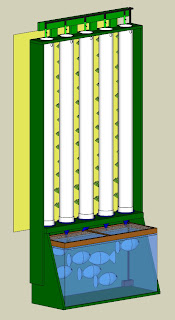
    Heres a drawing and a photo of the integrated vertical tube aquaponics system we built. The photo shows the tubes in the planting/harvesting position; normally they are rotated 180 degrees so that the openings face the window.


    Aquaponics Vertical grow

    Aquaponics, ækw??p?n?ks, pisciponics
    Aquaponics, ækw??p?n?ks, pisciponics

    To make the grow tubes, I cut slots across with a hack saw and then heated the plastic with a heat gun to soften it. Once it was soft I pushed in a tapered wooden plug to hold it open until the plastic hardened again. I did this outside because the PVC gives off some fumes when you heat it. The second photo below shows a close up of one of the openings after the tube was filled with pea gravel.


    Aquaponics Vertical grow


    Aquaponics, ækw??p?n?ks, pisciponics

    Read more

    Sunday, March 20, 2016

    Pollination in an Aquaponics system

    0

    One of the challenges of growing in an indoor aquaponics environment is that we don’t have nature’s pollinators available to us. But is this a big problem for most aquaponic gardeners? It depends entirely on what you are growing. The only time that you need to worry about pollination is when you are growing a plant to harvest its fruit (e.g. tomatoes, cucumbers, melons, etc.) or if you are saving seeds and you need the non-fruiting plants to produce seeds.


    Aquaponics, ækw??p?n?ks, pisciponics
    Aquaponics, ækw??p?n?ks, pisciponics


    Let’s start with a brief lesson on plant physiology and how pollination happens. Plant flowers actually contain reproductive parts known as ‘essential organs’. The male organ is called the ‘stamen’ and it is comprised of the long, stem-like ‘filament’ that is capped off with the ‘anther’ that contains the pollen. The female organ is called the ‘pistil’. At the top is the pollen receptacle called the ‘stigma’, followed by a tube called the ‘style’ which terminates in the ‘ovary’ which contains the eggs. Pollination is the act of getting the pollen from the male stamen into the female stigma so it can travel down the style and fertilize the eggs in the ovary. Flower petals attract insects to the flower which in turn unwittingly transfer the pollen (I’ll bet you are now realizing that this amazing plant sexuality is where the phrase ‘the birds and the bees’ comes from!).
    But not all plant flowers are ‘complete’, i.e. not all plant flowers contain both male and female organs. In fact, horticulturalists divide plants into four pollination categories based on the location of their essential organs.
    1. Self-pollinating - Complete flowers that don’t need insects or wind to pollinate them. This group includes beans, peas and tomatoes. Vibrating or tapping the flowers of these plants will help with release the pollen and promote maximum fruit production.
    2. Requires pollen from an unrelated plant. The only vegetables in this category are cabbages and radishes, and pollination is only required if you are growing the plant for seed.
    3. Cross-pollination group. These make up the largest group and each plant has both male and female flowers. This group can be broken into two subgroups.
      1. Windblown pollen – Vegetables in this subgroup are sweet corn, beets, carrots and onions. Of these, only corn needs to be pollinated for food crop production as the corn kernels are actually seeds.
      2. Pollinated by insects – Some of these vegetables are self-pollinating, but the fruit set will be greater if insects visit the flower. Fruits and vegetables in this group include broccoli, collards, cauliflower, cucurbits (cucumber, cantaloupe, pumpkins and watermelon), okra, peppers and squash.
    4. Male and Female plants. The best examples are asparagus, spinach and some hybrid cucumbers. Again, pollination is only required if you are growing the plant for seed.
    The bottom line is that unless you are growing plants to save their seeds, the only time that you will need to become actively involved in the transfer of pollen from the male organ to the female organ is with the Cross-Pollination group that is pollinated by insects (Group 3.2). And in this group the only fruits and vegetables that you can practically hand pollinate are the cucurbits (cucumber, cantaloupe, pumpkins and watermelon) because they have large flowers. How do you do this? Early in the day, while there is a lot of pollen on the flowers, follow these steps:

    Aquaponics, ækw??p?n?ks, pisciponics
    Aquaponics, ækw??p?n?ks, pisciponics


    1. Identify the male and female flowers. The female flowers have the stigma, which receives pollen, and the male ends have a stamen containing pollen. The pollen can be any color, including a light yellow, dark yellow or white.
    2. Touch the stamen of the male flower to make sure it is ready for pollination. If your finger has pollen on it, the stamen is ready.
    3. Touch the tip of the stamen, or the anthers, with a cotton swab, artist’s brush or your finger. Pollen should adhere to the swab. You can also remove the flower from the plant and fold the petals back, exposing the stamen.
    4. Transfer the pollen to the female flower’s sticky stigma.
    5. Repeat the process until you have pollinated as many of the flowers and plants as you desire.


    Aquaponics, ækw??p?n?ks, pisciponics http://aquaponics-commercial-backyard.blogspot.com.es/

    Read more

    Sunday, March 13, 2016

    PVC Strawberries growing system

    0

    Growing in PVC is not a new concept.  I have seen other people do this so I followed "some" of their ideas and put it into a working system with my Aquaponics.  I decided to grow some strawberries in mine. However, this could grow all kinds of things.

    What youll need...
    3 - 4" PVC 10
    1 - 1" PVC 4
    1 - 3/4" PVC 3
    6 - 4" PVC Caps
    4 - 1" PVC Elbows
    1 - 3/4" PVC 45 Elbow
    1 - 1"x10 Vinyl Braided Tubing
    4 - 1" Uni-seals
    2 - 3/4" Uni-seals
    1 1/4" Hole Saw bit
    1 3/4" Hole Saw bit
    3" Hole Saw bit
    1/4" Dripline hose
    3 - 3/8"x1/4" Brass Barb x MIP Adapter
    Hose Clamps
    Galvanized Steel Hanger Strap
    A few screws to attach Hangers
    3" Net Pots
    Fish Tank Pump*

    Lets chat about the Fish Tank Pump for a minute.  I put a star buy this as not any old pump will work. Depending on your system and the height that the pump is going to have to "push" the water up will determine what kind of pump that you will need. I have a RIO 2500 submersible pump in this system. I needed a pump that had a "max head" of 10. This pump also has a flow adjustment which is helpful for this.

    When I first put this together I attached the ends with 4" Elbows and attached all the pipes together and started it right up. I did run into a problem of the water just skimming on the bottom of the 4" tubes and not reaching my net pots. I finally found an guy on the internet who just glued in a sour cream lid in his to create a dam. Then through the growing season he removes them. That seemed like to much work for me so I changed out our ends and attached the 4" caps instead. I must say the whole system works great. No over flows and the net pots are getting water. By adding the caps and the holes in the middle of the caps this allows the 4" tubes to fill 1/2 way up and then drain. This ensures that your net pots will get wet.

    1. Drill your 3" holes in your 4" pipes. Depending on what your going to add you can have different spacing. I would recommend running a chalk line down the 4" tube (makes it easier to drill straight).  I spaced ours 8" on center. I have 14 holes in each pipe.


    2. Drill your end caps. 2 of the end caps will need drilled in the middle of the cap with the 1 1/4" hole saw bit.  This is for the 3/4" Uni-seal and the pvc pipe which will attach to the pump and at the very end. The other 4 caps will have the 1 3/4" hold saw bit, 1" Uni-seal and the pvc pipe. Also, on these 4 ends you will need to drill a 3/8 hole to fit the 3/8"x1/4" Brass Barb x MIP Adapter under the middle hole on the lower end of the end cap. This is to help drain the whole tube. (On a side note...Uni-seals are the bomb! I will never use anything different! They hold, dont leak and are so easy to install. I highly recommend them.)
    3. Put in the 1" Uni-seals and the 3/8"x1/4" Brass Barb x MIP Adapter in the 4 end caps. You will need a wrench to tighten the brass adapter. At this time cut 4 - 3" long 1" pvc pipe and put in the Uni-seal now. They are tough to put in...a little window cleaner will make it go in easier.

    4. Attach the end caps to the 4" pipe. Mine are not glued. They do have a drip leak every now and then but I want to be able to fix or clean out in the future. Hang your 4" pipe. You will need a helper for this. They need to be level and attached with the hanger straps.

    5. Now you just need to measure the distance between your 4" pipes to attach the 1" pvc pipe with the 1" elbows. Cut to length.

    6. The 2 end caps with the 3/4" Uni-seals are for the start and finish. Attach a 3" pvc to 3/4 Uni-seal. At the start where the pump is connected, you might need a different piece depending on what kind of pump you get. Mine is set up for 3/4" inner dimension. I had to get a grey sprinkler piece to attach to the 3/4" pvc coupling. I did glue this piece together. 
    7. Hose clamp the vinyl braided tubing to the 3/4" attachment and attach to pvc connector.

    8. Attach the end cap to the end of the system. You will have a different system than me so your plumbing will be different.
    9. Attach the 1/4" dripline to the 3/8"x1/4" Brass Barb x MIP Adapter and cut at the length you will need. I have them returning to my pond. Add your net pots.
    3" Net pot
    Net pots in 4" pvc growing system
    Your ready to go. My pump is in my pond with the rest of the pumps and is set on a timer. This pump only runs for 10 minutes every hour. I might bump it up in the heat of the summer if needed.

    I added a Parsley the other day and its happy.
    You will have to adjust for your system and what works best for you. This didnt take long to put together and it so far is working great. I did add a PVC pipe insulator to my vinyl braided tubing to keep the algae from growing in it. I could easily add on if I wanted to and since it is running off of my aquaponics system I will not need to add any solutions to it. Win win for me.

    Thanks for looking and Happy Planting!

    Read more

     
    Powered by Blogger