Showing posts with label and. Show all posts

Wednesday, June 1, 2016

The Science and Engineering of Smores

0

We realize this post is a few days too late for the first major camping weekend of the summer, but the truth is, we needed a tune-up on our smores theory and practice ourselves.  So now, while the extensive refresher training we completed over the last few days is still at the front of our minds, we wanted to put out a short treatise on the intricacies and nuances of marshmallow roasting and smore eating.

The first step in creating a smore is to initiate the thermal oxidation of some woody biomass.  To avoid marshmallow ignition, we want radiant heat from the coals rather than heat from the gas-phase oxidation occurring in flames. That requires full primary combustion of the wood, which takes a considerable amount of time.

The second step is to select a marshmallow roasting device from a nearby tree or shrub, taking care to avoid the species Toxicodendron vernix.  The geometric outlay of the device is to some degree a matter of personal preference, but weve found that a half inch diameter at the base tapering to approximately a quarter inch at the business end, and 2.5-3 feet long, to be optimal for most common campfire heat intensities and standard-size marshmallows.

Similarly, the optimal linearity of the device is a subjective matter.  Some prefer a higher degree of linearity to facilitate a uniform axial rotation during roasting. Others prefer some curviness to allow the roaster to reach preferred roasting locales within the campfire from any position around the fire ring, including those toward which the smoke is not traveling, and independent of other smore engineers who may be occupying prime roasting real estate.

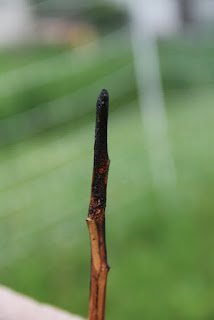
Nearly all experts agree, however, on the advantage of a barbed tip to prevent marshmallow disengagement from the device during the later stages of roasting, when the rigidity of the melty marshmallow core has deceased significantly.  Similarly, there is nearly universal agreement that removal of the bark from the tip of the device prevents inadvertent transfer of bark particles to the marshmallow.

In theory, pure radiative heat from glowing embers produces the most satisfactory roasting experience.  However, in practice, maintaining sufficient heat flow from a bed of embers over the course of tens of minutes that comprise a typical roasting session is challenging (as is having the patience to wait for the wood to finish burning down to coals).  Thus, the optimal sustained roasting environment often requires a combination of actively burning wood and pockets of glowing embers.

With the marshmallow applied to the roasting device, and roasting commenced over an appropriate heat source, the sugars in the outer shell of the marshmallow will begin to caramelize.  The primary chemical challenge during roasting is to uniformly caramelize the entire shell without charring or igniting any part of it.  The preferred technique among experts is a slow, rotisserie-style rotation at 4-6" from the embers, though few possess the patience to functionally sustain such an activity for the duration of the roasting operation. Another challenge is roasting the surface closest to the base end of the roasting device.  There may be some advantage to loading the marshmallow onto the device axially to minimize the surface area facing the base end (since the flat side of the marshmallow is smaller than the curved section), and then lightly smooshing the marshmallow to convert some of the base-facing surface into side-facing surface.

When the marshmallow is satisfactorily caramelized, it can be assembled into a smore, with graham crackers and chocolate as co-ingredients.  In some circles, a preferred embodiment of the smore is one which can be eaten cleanly (i.e., without loss of melted marshmallow to the eaters face or hand, or to the ground).  In such an embodiment, the chocolate and graham must be of the correct pliability, such that biting into the smore results in neither excessive compression of the marshmallow nor shattering of the graham cracker components.  The desired pliability can be achieved by mild heating of the graham and chocolate for 4-5 minutes while roasting the marshmallow (resulting in a final temperature of 100 - 105 °F).  More intensive heating melts the chocolate and toasts the graham, effectively exacerbating the problem.

A proper grip on the smore can also help keep the smore intact while biting.  As this hand model is demonstrating, a firm grip in one quadrant of the graham, using the end section of the first two fingers and the thumb, is optimal for minimizing transfer of marshmallow to the hand while maximizing the exposed area on which to apply the bite.  Large bites, up to the size of the entire smore, also minimize brittle fracture of the graham into the hand.

After roasting one- or two dozen marshmallows, the roasting device can be saved for future use, but a bit of maintenance and cleaning will help preserve its integrity and avoid attracting ants.  A first step in cleaning is commonly to remove as much marshmallow residue as possible by mouth.

Particularly recalcitrant residue can be removed by charring the tip, followed by wiping with an appropriate material, such as a t-shirt or nearby grass.  The health benefits of any residual char that may be transferred to future marshmallows are unclear, but related products are highly valued in some types of cuisine (an explanation of the scientific function of biochar in the digestive tract can be found near minute 19 in the video accompanying the previous link, although the entire episode provides a much more compelling narrative if one is amused by the non-sequitor nature of Japanese cartoons).  The roasting device can be stored somewhere relatively clean and out of the fire pit until needed again.

In conclusion, many factors must be considered to produce an optimally roasted marshmallow and a satisfactorily engineered smore.  We hope this primer has helped elucidate some of those factors, but we welcome additions and suggestions to incorporate into the second edition of this text.

What is your preferred marshmallow-roasting protocol?


Read more

Tuesday, May 24, 2016

Gloves Hats Tube Socks and Childrens Toys Needed

0

Image by secretlondon (OpenClipArt)
The Rock at NoonDay is seeking donations of certain items to distribute on Christmas Day. The guests--adults who are experiencing homelessness as well as some children--will receive the gifts as part of a special Christmas lunch, which will take place from 11:00-1:00 p.m. on Dec. 25.

Please take a few minutes in the midst of your Christmas shopping to buy new gloves, hats and white tube socks as well as toys for children for this special occasion.

Please drop off these items at the shelter, located at 2400 Second St. NW (map), on Sunday, Dec. 20, 11:00 a.m.-1:00 p.m., or on Monday-Wednesday, Dec. 21-23, 8:00 a.m.-4:00 p.m.

For more information, please contact Pastor Danny Whatley at (505) 220-6036

Read more

Monday, May 23, 2016

South Florida Gardening Winners and Losers

0

So if you follow this blog, you must think I died or quit gardening.  Quite the contrary.  While the rest of the country has been dreaming of gardening, Ive been doing it.

The South Florida growing season is drawing to a close and the rest of you are just getting started,  Here is what worked for me this year and what was a flop!

The Biggest Loser!

cucumber growing with aquaponicsBy far, the worst performers in my garden this season were the cucurbits!  I am not holding a pity party for them however.  They had much going against them, but they didnt give it much of a try.  I know I was not alone.  During a visit to a local nursery in January I overheard the staff in charge of the vegetable section tell a customer they had no luck with cucurbits either.  Our November was cooler than normal, followed by a December that was not only cool, but it was damp as well.  A quick review of cucurbit growing conditions does not include the terms "damp" or "cool".  I managed to get just a few Straight Eight cukes out of a raft using the Deep Water Culture (DWC) technique.  Growing a vining plant using DWC is always a challenge.  We ran string to get it to the garden frame and then just let it grow from there.  The plants in the flood and drain grow beds never produced at all. I ripped them out in January.  Despite many different attempts, I was not able to get new seeds to sprout.  Zero squash, zero melons, few cucumbers.  Cucurbits were a bust!

The Loser Runner Up!

Is there a runner up loser place at the podium?  I dont know if it is official place, but cucurbits were almost beat out by the nightshades as poor performers.  The cool and damp conditions were not embraced by the eggplants.  They were tolerated by the peppers and the tomatoes thrived so the nightshades mixed performance kept them out of the bottom position.  eggplant in aquaponics The irregular weather conditions resulted in problems with chlorosis.  I had to chelate more this season than I have in any season past.  This picture is a perfect representation of the eggplant problem this season.  I harvested less than a dozen fruits.  Usually I can keep eggplant going into May.  This year it was done by February. This is the second year I have grown eggplants relying solely on aquaponic methods. Last year was such a success!  This year not so much.  Next growing season, I commit to growing with and without soil. 

The Good Stuff

Now for the winners!  I tried celery in a flood and drain bed for the first time.  OK, true confession time, it is the first time I have tried to grow celery ever.  Maybe celery is easy to grow, maybe the cooler than normal temperatures were a factor.  I just know that it grew exceptionally well. It has been tasty too!
celery in aquaponics
So next year I will try celery again and see if it is a fluke.  As an aside, I discovered that celery leaves are pretty tasty when they are young but bitter when they are older.  It is awesome to harvest your celery and then not spend all that time in the kitchen scrubbing the dirt off.  That is an unsung benefit of growing with aquaponics, faster produce cleaning in the kitchen!


swiss chard in aquaponics
Another big winner were the greens.  I grew kale and swiss chard with lots of success.  The chards took a littler longer to get going this year, but once they got going, there was no holding them back. The chards and kale were grown in both NFT tubes and flood and drain beds.  I didnt try any of these in soil this season.


Last year, the greens in the NFT tubes were the big winners, this year the plants in the flood and drain beds out performed their tube counterparts.  It just goes to show that when it comes to gardening, there are always surprises. 

kale and celery in aquaponics 
This was my first season with Dinosaur kale.  It grows very quickly no matter the weather or light conditions.  Three plants were all that were necessary to provide more than enough for our table of 2.

The Winners!

The winners were the mints, including basil and the peppers and the tomatoes.  I had tomatoes in soil and tomatoes in my aquaponic gardens.  I tried something old, Mr. Stripey, something new, Arkansas Traveler, and something borrowed and blue, Indigo Rose!
basil in aquaponics
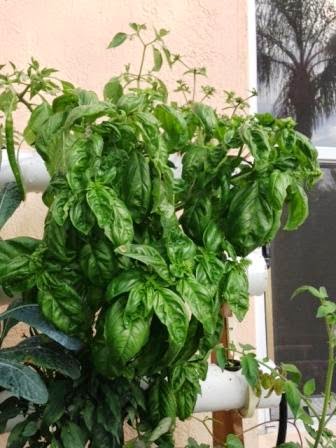
The basil went wild in the NFT tubes.  I had to end up moving a Dinosaur kale to make more room. 

indigo rose tomato and cayenne pepper in aquaponics
 This is an Indigo Rose growing in an NFT Tube with a little cayenne pepper poking out behind it.  The Indigo Rose seeds were from my sons garden in Ohio.  When I visited in August, I opened one of his ripe tomatoes onto a paper towel and spread out the seeds and flesh to dry.  I brought the dried paper towel home and planted it, towel and all in October.  The Indigo Rose was by far the most prolific producer.  I had them in DWC rafts, flood and drain beds and soil.  They performed well in all situations.  The only down side to this tomato is that it takes for-fricking-ever to ripen.  The portion of the tomato that is kissed by the sun turns a bluish purple, the remainder will turn red or yellow when the tomato is ripe. 
Arkansas traveler tomato in aquaponics
 This was my Arkansas Traveler when it was setting its first fruit.  I only had one plant this year, but will certainly save seeds (using the paper towel method) because this is a great tasting tomato. It doesnt grow extremely large in either plant size or fruit size.  When ripe, it is a pink color.  It is very tasty and low acid.
mr stripey tomato
This is a "Mr. Stripey" that was growing in soil in a pot.  A real down side to buying starter plants is that anyone with a sense of mischief can cause problem in the garden center.  I bought this plant as a start and it was clearly marked "Mr. Stripey", which happens to be one of my favorite tomato varieties.  As it began to set fruit, O started doubting the veracity of the tag.  The tomatoes werent as large as they should be and didnt exhibit stark striping.  When the first fruits started to ripen I knew I had been had.  The fruits turned red and not the beautiful orange-ish shade sported by Mr. Stripey.  I dont know who this imposter is, but it produces a medium sized red tomato with very light striping.  Unlike Mr. Stripey, it is very low acid. I am not saving the seeds.  I considered prosecuting it for impersonating a beloved heirloom, but decided the real culprit was the person at the garden center, not the plant.

Inedibles in Closing

  Believe it or not, the winter months arent all about vegetables here at the end of the peninsula.  The shorter days mean that lots of plants start to bloom.  While you are looking at snow, Im looking at kolanchoes.
 Im enjoying the orchid blossoms.
 
And the Bolivian gloxinias start to bloom before Christmas and take us all the way through to Easter.
 
My season was a mixture of hits and misses.  Let me know what you are doing to make your season a success.  Id love to hear from you!

Read more

Sunday, May 22, 2016

Books Review 50 and up Underground House Book Earth Sheltered Solar Greenhouse Book by Mike Oehler

0

First, a confession: were huge fans of underground/earth-sheltered structures.  Cooler in the summer, warmer in the winter, virtually immune to tornadoes, nearly invisible to alien invaders...the list of perks goes on and on.  Were also cheap. (Pronounced frew-gull.)  As it turns out, Mike Oehler probably has similar tastes. 

Covers of the relevant books.  The drawing on the cover of the $50 and up book is one of the less spectacular designs in the book, but shows how underground structures can be built even on relatively flat ground.  The drawing on the cover of the greenhouse book shows many of the features of Oehlers design, namely a lower section for standing room, trapping cold air, and potentially sheltering rabbits; a back wall with thermal storage devices, and a roof with venting capability.  We found a copy of the $50 and up book here, and the greenhouse book here.

In the foreword to the greenhouse book, Rob Roy (another underground house expert with his own series of books) says,
"Ive always prided myself on sharing information on low-cost green building techniques in my books, but Mike out-flanks me every which way from a Mexican Sunday: the guy builds cheap, dirt cheap, and I say this with begrudging admiration." [Mexican Sunday is another of Oehlers books.]
The books are an entertaining and immensely useful guide to earth-sheltered buildings. Oehler brilliantly mixes personal experiences of building underground structures on the cheap with curmudgeonly (to use Oehlers own words) but endearing political commentary. (How many other books have an entire chapter devoted to circumventing building codes and fooling building inspectors?)

While most other sources on underground buildings advocate the copious use of concrete and insulation materials, Oehler explains how to design and build stable, structurally sound earth-sheltered buildings (provided building codes are not viewed as gospel truth) with materials scrounged, sourced from the homestead, or readily available at the local hardware store: mainly wood and plastic sheeting.

The steps and principles of construction are simple:

  1. Dig a hole, optimally on a ridge if a view of the surrounding area is desired, but optionally on a hillside or even on flat ground.
  2. Construct a post-and-beam frame in the hole, making sure to place a layer of polyethylene between wood and dirt, e.g., in the holes for the posts.  Also make sure the frame is braced against itself to keep the force of the dirt that will be added outside the walls and on the roof from buckling the frame.  In the greenhouse book, Oehler also mentions that he now chars the bottom end of the posts in a campfire to further preserve the wood.
  3. Add shoring on the outside of the frame in the form of lumber mill ends, scrounged boards, etc., again making sure that there is always plastic sheeting between the wood and the dirt.
  4. Backfill around and on the structure with dirt, making sure to allow for proper drainage.

Naturally, there are numerous details to each of those steps that Oehler outlines in the books, gleaned through his considerable experimentation with underground structures and experience in the construction industry.

Oehler walks readers through his methodology, which is arguably based on a series of questions:
  1. What do I want out of the underground building?  
  2. What is the simplest (and cheapest) way I can build a structure that gives me what I want out of the building?
  3. What are the problems with the simplest structure, and what can I do solve them?
  4. What are the problems with the improved form, and what can I do to further improve the building?
  5. ...and so on
Not only is this approach an incredible time-saver for folks like us, who tend to follow the same protocol, but the fact that Oehler has resolved these problems to a sufficient degree to live in his self-built underground houses for decades and to harvest vegetables year-round from his underground greenhouse near the Idaho-Canada border speaks to the soundness of his approach.

Criticism of these books is hard for us to muster.  Oehler calls it like he sees it, which is mostly endearing.  For example, as implied above, we learn straight away that he has a strong disdain for authority in general and especially government involvement in the everyday matters of rural life.  However, one doesnt have to read very far between the lines to guess that Oehler might be a little bit vindictive, even if the vindication comes in the form of somewhat petty remarks in the figure captions of his books.  But the cumulative effect of these comments does very little to detract from overall excellent works.

In sum, we are very happy to have Oehlers experience to draw from when we have a need for some outbuildings on our own homestead and will very likely use some of his techniques.  We highly recommend these books!

Read more

Saturday, May 21, 2016

Interfaith Procession and Candlelight Prayer for UN Climate Meeting Scheduled for Monday November 30 in Albuquerque

0

The Interfaith community in Albuquerque is coming together on Monday, Nov. 30, for a procession and candlelight vigil ahead of the upcoming UN Climate Talks in Paris. The vigil begins at 5:30 p.m. at the Federal Building, Gold and 6th SW, and ends at Immaculate Conception Catholic Church, 619 Copper Ave. NW  Here is a map (Note: The exact route will be announced later. The map just shows the starting and ending locations)

Even as the world is reeling from the violence in Paris, World Leaders from more than 150 nations prepare for the UN Climate Change meeting in Paris, November 30-December 11. An unprecedented number of leaders of religious traditions, including Pope Francis, the Dalai Lama and Muslim and Jewish world leaders are calling all people to act for climate justice. They will offer a moral voice to public officials as they meet to agree to an international agreement.
 

You are invited to participate in a special prayer for the meeting and to bless those from Albuquerque who will be traveling to Paris for this important gathering.

Order of evening:
*Procession calling to mind the many climate refugees
*Candle light prayer in Immaculate Conception with music, sacred dance, prayers by major religious tradition representatives, blessing of those going to Paris and blessing of those representing organizations that will be in Paris, call to action.

Co-sponsors: New Mexico Interfaith Power and Light, New Mexico Conference of Churches, New Mexico Oxfam Action Corps, Bread for the World-New Mexico, Catholic Charities of Central New Mexico, Catholic Archdiocese of Santa Fe, and others.

For more information contact Sister Joan Brown (joan@nm-ipl.org).

Read more

Heart Association Reduce Price for Fruits and Vegetables and Save 200 000 Lives

0

For years, the American Heart Association (AHA) was identified with a campaign to reduce consumption of red meat.  In lieu of eating so many ribeyes or sirloins or fast-food hamburger, the AHA recommended that people obtain their protein from chicken, fish or beans.

The heart association is also recommending greater consumption of fruits and vegetables, which  the group says should be more affordable. At the AHAs Epidemiology meeting meeting in Phoenix this week, experts said a 30-percent reduction in the price of fruits and vegetable could save nearly 200,000 lives over 15 years. That is roughly the population of Des Moines, Iowa.

Heres what a report in National Public Radio said this week:
"Computer models suggest that making that produce more affordable may actually translate into lower death rates from heart disease and stroke. And, the researchers add, lower prices are more effective at saving lives than traditional campaigns designed to encourage consumption of fruits and vegetables, like 5 A Day. 

The conclusion is based in part on a tool developed by researchers at Tufts University and in Britain called the U.S. Impact Food Model that included projections of U.S. demographics and cardiovascular death rates to 2030. They then combined the data with current and projected fruit and vegetable intake figures. The model allowed the team to simulate the effects of different policies on eating habits.

"We were able to take a given change of price, and [determine] what that change in price does to consumption levels," lead researcher Jonathan Pearson-Stuttard, an academic clinical fellow at Imperial College in London, told NPR.

Read the full NPR article.

Read more

Friday, May 20, 2016

An Action Plan for Healthier Farms and People in New Mexico

0

New Mexico faces a stark paradox: ranking close to the top of the list in food insecurity and child and senior hunger, while about one-quarter of our population suffers from obesity and numerous diet-related chronic diseases. Public meal programs are critical opportunities for addressing the health and well-being of New Mexicans and there is real promise for those fruits and vegetables to be provided by New Mexico growers. -from The Power of Public Procurement: An Action Plan for Healthier Farms and People in New Mexico,September 2014
Cover: Seed Art Mural, Bernalillo County Youth Detention Center
Photo Courtesy of: Jade Leyva, Curator for SEEDS:A Collective Voice Multimedia
Exhibits, Community Seed Mural Projects Co-Artist & Coordinator


Over the past week we published blog posts on the links between health and hunger from the Bread for the World Institute, New Mexico Voices for Children and and First Choice Community Health Care. An important aspect of providing healthy food to the population, particularly low-income communities, is to ensure that fruits and vegetables are available at affordable levels. The produce does not need to be trucked from California. Rather, there is an abundance locally.

A little more than a year ago (in September 2014), Farm to Table and New Mexico State University (via the Department of Agricultural Economics and Agricultural Business, the Department of Plant and Environmental Sciences and half a dozen agricultural extension offices) published a report that attempts to identify and understand the potential and current barriers that New Mexico farmers and New Mexico’s public institutions face when trying to sell and purchase locally grown fruits and vegetables for their respective meal programs.

The report, entitled The Power of Public Procurement: An Action Plan for Healthier Farms and People in New Mexico, recognizes that a potentially significant market exists for the sale of New Mexico grown produce to the State’s public institutions. This is particularly true for the school districts’ food service programs.

"A large, and until recently, untapped, commercial exchange may be fostered between fruit and vegetable growers and the public officials who administer the procure-ment systems of public institutions," researchers said in the executive summary of the report. "Yet, practicalities and barriers currently impede the process."

The authors of the report make a number of recommendations at various agency and inter-agency levels, placing a strong emphasis on schools, but also on senior centers, state corrections institutions, and farming and agriculture.  Read the executive summary and the full report.

Read more

Aquaculture and Agriculture in Harmony

0

Points to consider based on experiences in the Prairie Region of Canada. Dec 19 2005

Recent times have seen an increased interest in Aquaculture as a potential opportunity for farm diversification; this renewed interest is encouraging and worthwhile. Much of this new interest is at a grass roots level where individual family farms are actively seeking alternate forms of agriculture and new economic opportunities. However this heightened awareness will fade unless concrete and solution oriented efforts are made at mitigating the potential knowledge and educational constraints faced by many would be participates.

To successfully integrate commercial scale Aquaculture production into an existing agriculture farm the economic considerations must be carefully examined. A farmer must be able to review and access the potential long-term benefits and become convinced that they warrant the investment required. The potential risks must be fully explored and accounted for within any financial modeling. The operation must also be planned to make the best synergistic use existing assets while still being capable of performing at an economically viable level.

I have over the years realized (through trial and error) that farm design alone does not guarantee success in the business. Sure, there are many new and exciting technologies emerging bringing improvements are good for the industry. It is exciting that recent advances greatly improved the performance, sustainability eco-friendliness of the industry. New farm designs and system technologies have made it possible that Aqua Farms can be operated in areas with limited water supplies and can be combined with other crop production to create even further on farm diversification. The technology are great and required, but Technology alone does not guarantee success.

Future fish farmers will also require comprehensive data dealing with production options, alternatives, investment required, operational costs, benefits to existing operations and other social economic factors. In addition the farmer needs to have access to training and skills development and longer term support for continual evaluation, refinements and business expansion.

Without training, good knowledge and proper management resources, it is unlikely that the average farmer wishing to diversify into aquaculture will be successful. Commercial scale Aqua Farming can require a sizable financial investments making knowledge and management ability all the more important in protecting and achieving a return on investment.

Most of the key deciding factors governing Aqua Farming investment decisions are not readily apparent or within easy access to the general public. In Manitoba, this lack of knowledge combined wuth the absense of a facility (or means) to witness the demonstration of working viable models, creates a justified roadblock in the minds of people that would otherwise embrace the opportunity. Many potential farmers do not yet have a comfort level sufficent to make the decision to invest in the industry. Their thoughts could be expressed as “let me see a working example and a business plan then I can determine if it can work for me”.

At this stage, it wouldn’t be wise to encourage new industry entrants "to attempt to duplicate a full scale commercial farm" without first getting their feet wet and gaining first hand knowledge and training.

However if the private sector and public sector collaborate in a mutually beneficial way it is likely that more effective co-sponsored research and development activities can be undertaken providing timely support to commercial operators while ensuring that more potential operators will be able to access top level up to date knowledge.

An effective means to demonstrate the farming process in a practical and scalable fashion will encourage further commercial development. Farm demonstration and training are two key ingredients in fostering future aqua farm development. These have to be made available in a manner that fits with the time and financial resources of the existing agri-business owner.

Smaller scale demonstration type farms are required to trigger growth of the provincial industry while allowing lower levels of risk exposure by future operators.

Commercially oriented demonstration farms with an information exchange component have been proven effective in furthering the development of fish farming in other locations.

Related Article “Starting a New Aquaculture Business? – Here are some suggested guidelines to help ”

Read more

Thursday, May 19, 2016

Prayers and Reflections for the Third Sunday in Lent

0

Todays Readings
Isaiah 55:1-9    Psalm 63    I Corinthians 10:1-13    Luke 13:1-9


from Bread for the World

Read more

Wednesday, May 18, 2016

Climate Change is an Ethical and Moral Concern

0

The Circo for the Community fundraiser on Saturday, March 5, will benefit five organizations, including New Mexico Interfaith Power & Light (NMIPL). Here is a preview of a full video that will be shown at the fundraiser, which will also benefit the New Mexico Conference of Churches, La Mesa Arts Academy, the New Mexico Faith Coalition for Immigrant Justice (NMFCIJ) and the Albuquerque Aerialist Collective.  (We posted a video from the NMFCIJ earlier this week).Tickets are $35 and can be purchased on the NMCC site or at the door (you can write a check for any of these organizations). The cost of the ticket includes dinner and a reception.

Read more

Tuesday, May 17, 2016

Food Month and the Goal of ZeroHunger

0

 (Reprinted  from Bread Blog)

We are committed to ending hunger by 2030, but can we really achieve #ZeroHunger in 15 years?

October is traditionally “food month.” It’s the month for World Food Day (Oct. 16 this year), and it’s the time of the annual Iowa Hunger Summit and the award ceremony for the World Food Prize. (And don’t forget Bread for the World Sunday on Oct. 18.)
Bread is involved in many of these events, and you are invited to observe or participate in them as well. Bread will be reporting on these events on our blog and social media channels.

Read more

Monday, May 16, 2016

Newfoundland and Aquaculture Training

0

New aquaculture program to start in August.

I am always on the look out for news relating to Aquaculture. I also have a self admitted fondness for reading about new things or events that demonstrate an educational improvement.

Recently I read a news story in "The coaster Online" and here is what I think.

First off, Its good news that the Keyin College will be offering its first ever Aquaculture program at St. Alban’s Newfoundland, in August 2007. Early indications are that it is comprehensive program.

The press release states " The new program is designed to introduce students to the history of aquaculture, give them an overview of the state of the aquaculture industry and to prepare them for all facets of the industry which is growing rapidly, especially in the Coast of Bays region.""

Heidi Middleton, human resources manger with Cooke Aquaculture said "their hiring practice will give preference to candidates with a background in the industry".

Cooke Aquaculture is a significant stakeholder in the Atlantic Canada Aquaculture industry. The company in recent years, has enlarged its business by expanding into new locations and diversifying its operations.

Heidi goes on to say " A candidate can gain experience in the industry in one of two ways: by obtaining an Aquaculture Technician Certificate through a recognized learning institute like Keyin College or adequate years of hands-on industry experience. These employees will be compensated at a higher starting rate."

She also notes that " many existing Cooke Managers possess an Aquaculture Technician accreditation."

The press release also points out "Once they complete the program students will have the skills to become aquaculture technicians with the opportunity to obtain long-term employment in one of the growing industries in the province. Cooke Aquaculture has invested millions into its operations in the region, as well as companies such as the Barry Group of Companies."

I see this new program as another welcome sign of advancement within Aquaculture Industry, particularly as it relates to my home province. (I am not shy)

Certainly the duration of the program is lengthy enough to provide for a wide range of learning opportunities covering the important aspects of the industry. Experience has thought me that training programs which include a good effort at providing a backgrounder to the history and nature of the industry, combined with the fundamentals of practice, offer more for "both" the students and prospective employers.

Persons that achieve a good working knowledge of the industry while gaining an understanding of the history and of its present day importance as a sustainable food source, are in my opinion "The Class Act", and represent the future of the industry.

I look forward reading future updates of this program and its progress.

News Story Reference: Special To the Coaster June 5 20007

Read more

Sunday, May 15, 2016

Water Hardness and ph in aquaponics

0

Most of us aquapons know that the health of all the creatures in our systems (fish, plants, worms, and bacteria) depends on proper pH. We also know that we are targeting pH in the 6.8 to 7.0 range but that we don’t have to worry about adjusting it until it goes down to 6.4 or up to 7.8. We also know that the best way to lower pH is with an acid, and that the best way to raise it is with carbonates or hydroxides. We know that rapid changes in pH can be very stressful to fish. And we know that the pH will probably decrease over time because the nitrogen cycle produces an acid (nitric).
But often, knowing all of this and applying it to our systems are two different things. At The Aquaponic Source, we handle questions and concerns each and every day about pH. Generally, the questions fall into one of two categories:


  1. - The water out of my tap is a pH of 8 (or more) and I can’t seem to lower it reliably. What should I do?
  2. - The pH in my system is dropping constantly and I have to add something to raise it almost daily. Is this normal?
Most pH mysteries in aquaponic systems boil down to how ‘hard’ the water is that we put into our systems. This ‘hardness’ dictates the buffering capacity of water… Let me explain.
Water from most sources has some level of mineral salts dissolved in it (purified water such as distilled or RO [reverse osmosis] filtered are clear exceptions). Among these dissolved salts are certain specific minerals that strongly affect your water pH. The concentration of these minerals in your water is often described by the term ‘hardness’, the higher the concentration of these minerals, the ‘harder’ your water is. There are two types of hardness in water: ‘carbonate hardness’, (KH), which is sometimes also referred to as the water’s ‘buffering capacity’ or ‘alkalinity’ (not to be confused with an ‘alkaline’ solution which would have a pH greater than 7) and ‘general hardness’ (GH) which refers to the concentration of calcium and magnesium ions in the water.
The general hardness of the water affects pH but it is the buffering capacity (KH) of your water that is the more critical pH factor. This buffering capacity acts like an invisible sponge that soaks up whatever acid or base is in your system, or that you add to your system, until the buffer is ‘used up’. With this sponge-like behavior in mind, imagine trying to adjust your pH. Let’s say you have a pH of 8.0 in your aquaponics system and you would like to bring it down to 7.0. You start adding our AquaDown pH Lowering Agent, and adding, and adding, and little or nothing changes. And then all of a sudden the pH plummets. What has happened? You had a strong buffer (meaning there was a lot of KH) in your system which you eventually ‘overwhelmed’. Another way of thinking about this is that you ‘filled up’ the sponge.
You can actually measure your KH level and doing so may help you manage your pH. The larger the KH number, the more resistant your system will be to attempts to alter pH. Having a higher KH level can be beneficial in a fully cycled system because the nitrification process produces nitric acid which will persistently drive pH down in an unbuffered environment. A rule of thumb is that a KH of less than 4.5 dH (degree hardness) means that you don’t have much buffering capacity and you should be checking your pH a few times a week.
How do you increase your system’s buffering capacity? When you are fully cycled and your pH drops below 6.8, add calcium and potassium carbonate (the ingredients in our AquaUp pH Raising Kit) on a regular basis once you have fully cycled and start seeing your pH decrease below 6.8. You will find that over time, you will build an excellent buffer and your system should become more and more pH stable.


Aquaponics, ækw??p?n?ks, pisciponics http://aquaponics-commercial-backyard.blogspot.com.es/

Read more

Friday, May 13, 2016

Sustainability and Aquaculture

0

People have been farming fish for thousands of years. Today, a wide range of plants and animals are grown in aquaculture farms both on a commercial scale and subsistence level. As a result of the growing world population and a shift in western societies towards healthier eating patterns commercial scale fish farming has had to expand to fill the need for fresh fish and seafood. Aquaculture is well suited to meeting this increasing demand for seafood. Out of need, we realized as a society, centuries ago, that we could not sustain ourselves with hunting and gathering of land foods. Much the same today, we must also face the very same facts when it comes to harvest of the waters.

Commercial scale fish farmers and western consumers are not the only beneficiaries of increased aquaculture production. Several low-income food-deficit countries are big aquaculture producers. In these countries aquaculture contributes to poverty alleviation and to the enhanced supply of fish products to poor people in rural and urban areas.

In addition to the massive direct food production benefits, fish farming technologies also play a supporting role to the wild fishery by making possible fish restocking and enhancement activities and by filling a complimentary niche in export markets. Indeed the sharp decline in some “wild fish Stocks” is mitigated in part by supplemental production of young seed stock in hatcheries.

The inherent efficiencies of farming versus fishing for the wild catch (hunting) will continue to further a progressive switch from fishing to fish farming. In the late 1990’s the FAO estimated that the cost of catching fish in the wild, on a global basis, was already about 25% higher than the true value of the catch. Much of the difference was made up in subsidies and other forms of financial support.

Alternative Production Methods and Advancements in Aquaculture

Land based aquaculture is a food sector that is sustainable, renewable and provides safe high quality food products to consumers while creating considerable benefits for the general population. Based on science and technology, it is a market driven sector that has emerged to provide consumers with value, taste and convenience in consumption of seafood and other Aquatic products similar to that expected from other food commodities.

Aqua Farming requires clean growing waters to maintain a satisfactory level of production. Therefore, the industry has to encourage environmentally friendly practices and has taken many practical steps to protect the local environment. In fact without ensuring protection of the environment, the industry itself would flounder. Such safeguards include government measures controlling the introduction of new species and the transfer of fish, fish health protection, better site selection, and actions to minimize fish escapes and prevent waste discharges.

Land based fish farms that utilize technology to recycle and reuse water supplies and to prevent waste discharge and fish escapement are among the most eco-friendly and sustainable methods of aquaculture. Farms that incorporate water recirculation aquaculture systems into their design are proven to be the most eco-friendly of all commercial fish farms.

Taking these systems one step further involves the incorporation of polyculture techniques, where plant crops are grown with the nutrients produced by the fish crop. This is known as Aquaponics a farming technique that is becoming more common in the design of both small and larger scale farms. Land based farms using Aquaponics is one of the most promising of alternative aquaculture practices.

Aquaculture books and reference materials.

Read more

Thursday, May 12, 2016

Aquaponics and Iron

0

When I very first started learning about aquaponics I was under the misconception that if you kept the fish alive and happy the plants would automatically be happy.

How many of you have fallen for the mis-information touted by some who only want to sell you their aquaponics-related product?  They will tell you that an aquaponic garden is a totally closed system that only needs the addition of food for the fish.  I also read that aquaponic gardens require little to no care.  Pfffftttt.

My aquaponic gardens are in many ways more easier when it comes to care but they are not care-free.  One thing that is common to both aquaponic gardens and soil gardens is chlorosis, or a need for iron.  Because the deficiency interferes with chlorophyll it is fairly easy to spot.  The leaves will become light yellow but stay dark around the veins.

 Iron in Aquaponics Explained by Nate Storey is a great place to learn exactly how iron acts in an aquaponic situation.  In a nutshell iron may be unavailable in aerobic situations.  Since growing with aquaponics is aerobic, you need to dose with iron on a regular basis.
Here is a picture of one of my sweet basils that needed a dose of iron.  As you can see, other than the color of the leaves the plant looks "normal".  Tthis is not healthy for the plant but it is common in aquaponic gardens, especially if your pH gets on the high side of the scale.

I use Fe EDTA because it is available to the plants even in a high pH situation.  This isnt true if you use something like seaweed fertilizer.  I read lots of folks raving about seaweed fertilizer for their aquaponic systems but I dont see iron (either present or in a form available to the plants) ever listed on the label.

The Fe EDTA I use is just the iron in a 6% strength.  It works.  It is not terribly expensive.

Just look at how this basil responds in just a few days.  Hard to believe that is the same plant isnt it?  Looks much more tasty to me! 
Basil After Iron

The "experts" say to dose your aquaponic system on a regular basis with iron.  I only dose my system at home when it shows signs of chlorosis.  At the Together We Stand gardens, we dose about once a month because the pH of the water stays high.

Aquaponic gardens can be easier than gardening with soil, but it still requires your attention.  You just dont have to weed and water!  Instead you have to do things like feed the fish and monitor water quality for ammonia, nitrites and nitrates. 

Read more

Tuesday, May 10, 2016

Dance Pray Walk Barefoot and Take Legislative Action During Climate Talks in Paris

0

The faith community and people of conscience in Albuquerque and Santa Fe took a number of actions during the conference on climate in Paris (COP21) on Nov. 30-Dec. 11. An interfaith vigil in Albuquerque brought members of the Jewish, Christian, Muslim, Buddhist, Sikh and other traditions for a procession and a prayer service in Albuquerque on Nov. 30. The service, which was held at Immaculate Conception Catholic Church, was planned to coincide with the departure of Sister Joan Brown and Sister Marlene Perrotte of New Mexico Interfaith Power and Light  to the talks in Paris the next day.  Below are a few snapshots of the service.

Rev. Sylvia Miller-Mutia and her family led liturgical dance
Father Warren Broussard, Sister Joan Brown

Necip Orhan
Ruby Kochhar and fellow member of Sikh community

Rabbi Arthur Flicker
Legislative Advocacy
The local actions in conjunction with COP21 included opportunities for advocacy and an activity on the Plaza in Santa Fe this afternoon (Wednesday, Dec. 2). The legislative advocacy efforts include actions at the federal and state levels. We are asked to urge our members of the New Mexico State House and Senate to pass the Home Renewable Energy Tax Credit and to advocate to Sen. Tom Udall to vote to vote to fund the U.S. contribution to the Green Climate Fund.


Barefoot on the Santa Fe Plaza

Organizers of the "Shoes of Solidarity" event asked people in the Santa Fe area to bring their shoes to the Plaza on Wednesday, Dec. 2, 4:00 to 5:00 p.m.  (or anytime thereafter until Dec. 11) in solidarity with the COP21 summit. "Please place your shoes on the grassy areas only. Take the time to invite your neighbors and friends to join you as a statement that New Mexicans want the climate restored to a safe, stable level, and that you want to see New Mexico leaders mobilize for serious climate action," said organizers, who created a Facebook event  to publicize the action.

Read more

Sunday, May 8, 2016

A Free Healthy Meal Seven Days a Week for Children and Youth in Albuquerque

0


Are you between the ages of 3 to 18 or have a child who is in that age range? If so, you can receive a free healthy meal at the Presbyterian Hospital cafeteria between 1:00 and 7:00 p.m., seven days a week.

The cafeteria is located on level 5-2, north side of the hospital, located at 1100 Central Ave. SE (map)

No identification is necessary, and any child or youth of 3-18 years of age qualifies.

You will need to order from a cashier and sign a log showing that you received a meal. The meal must be eaten at the hospital. A voucher is not necessary. 

The program is sponsored by Presbyterian Community Health.

Read more

Learn About Roadrunner Food Banks Program to Link Health and Hunger

0


Quarterly Meeting on Tuesday, February 9  12 Noon

First Presbyterian Church (I-25 and Martin Luther King Blvd.)

Alissa Barnes, director of Community Initiatives at Roadrunner Food Bank, will talk about the food banks new program on health and hunger.  Alissa is a member of the Interfaith Hunger Coalitions Advocacy Committee.

Our Education and Advocacy Committees will also present updates of their work over the past several weeks.  We are also seeking volunteers to serve on a committee to plan an Interfaith Service for World Food Day on Sunday, October 16, 2016

https://blogger.googleusercontent.com/img/b/R29vZ2xl/AVvXsEhCebs6EOwA3iC2hm1jHsYX-t9SPgr1jqzyBJAI7MCACOaxNeeBucsh6NdKK6we8Jcen_1XFgb51bNOhbq6SwIOQ8c6Tox1UAVwDu1gD6h1FyiEtz86p8sfAa7HsKn9o5i9cEE8QsVdGAzn/s320/FarmDay2.jpg

Data shows us that food insecurity and health go hand in hand. Food-insecure individuals are more likely to experience colds, stomach aches and migraines and suffer from generally poorer health than food secure individuals. In 2014, Feeding America conducted the Hunger in America study and found some staggering statistics  about New Mexico’s pantry clients:

  • Nearly half (46%) report being in poor or fair health;
  • 59% report choosing between paying for medicine or medical care or buying food at least once in the past 12 months;
  • 44% of hungry households said they have medical bills to pay, and;
  • 75% report purchasing inexpensive, unhealthy food as the most common way to have at least some food at home to eat.
As a food bank , we are focused on addressing Health and Wellness and leading in the national trend of food banks partnering with health organizations. We were pleased to share some of our Health and Wellness Initiatives with the Beyond Flexner Conference.  The conference brought a group of medical students, educators, and physicians together  to discuss social determinants of health.

More information in these links:
Healthy Hubs – Partnering with Organizations to Increase Health Outcomes
Working Together for a Healthy and Well Nourished New Mexico
Healthcare and Food Delivery Advisory Council Meeting Report

Read more

Quick and Dirty Rustic Chicken Tote

0

Today is the last day for our fall crop of meater chickens.  We were originally planning to do all the processing in-house, but found out that our local ordinances explicitly forbid livestock butchering because...well, were not really sure why.  Probably some city official is worried about raccoons and dogs finding the offal and dragging it around the neighborhood.  Anyway, we looked for other options, and found a (fairly) local farm that will do it for $3.00/bird if we stay and help.  Not too bad, and very nice folks.  Now we just need a way to transport the chickens there and keep them calm and contained while theyre waiting for their turn at the cone!

Fortunately, weve collected a bunch of pallets for a project just like this.  Here we start with one like this, but if we were luckier, we could have found one with the board closer together.
But we werent luckier, so now we have to fill in the gaps with boards from a different pallet.  If we were lucky at all, wed have at least found pallets that were the same width!  Oh well.  At least they were free!  Were only going to use half of the pallet for this project anyway, so having a few boards that dont go all the way across isnt a big deal.
We screwed the new boards in place and cut down the the far side of the middle runner.  Notice that theres a bit of the runners sticking out toward the top of the picture.  Thats because we wanted to make it the same length along the sides as the pallet boards were going to use for the walls, which in this case is 40".
We cut the runners to the right length and used more pallet boards to make corners.  We made the boards 24" long so that the height from floor to the top would be about 20".
Here it is with more pallet boards as the walls.  No cutting required for the long sides!  Note that the quick part of the title only applies if there are a lot of already-deconstructed pallets around.  Also note that the boards arent stacked super tight.   That lets the chickens get some air, and it lets us use up some of the crummy wood that split while we were deconstructing the pallets.
Fit test #1: Pass!  Plus theres enough room for the cooler alongside!  With the seat down in the Saturn, the front is higher than the back, so we added a hunk of 4x4" to level it.
Fit test #2: Also pass!  All eleven fit in there comfortably.  We could actually fit four or five more, but it would be a bit tighter.  We could have probably made it a bit shorter also.  Fit test #3 is that we can lift it with all the chickens inside.  The tote itself probably weights 30 lbs., and the chickens are probably another 40 lbs. (Well know in a bit!)  Fortunately, Katie is strong like whiskey!
To keep it dark (which calms the chickens), we could make a wooden top with a hinge, but it also works fine to just use a blanket.
Check back on Thursday for the final stats on our fall batch of chickens!  Well have all the numbers crunched and post our weights, costs, and average conversion ratio.

How do you transport your chickens?  What do you do to keep them calm while theyre awaiting processing?  Let us know in the comments section below!


Read more

 
Powered by Blogger